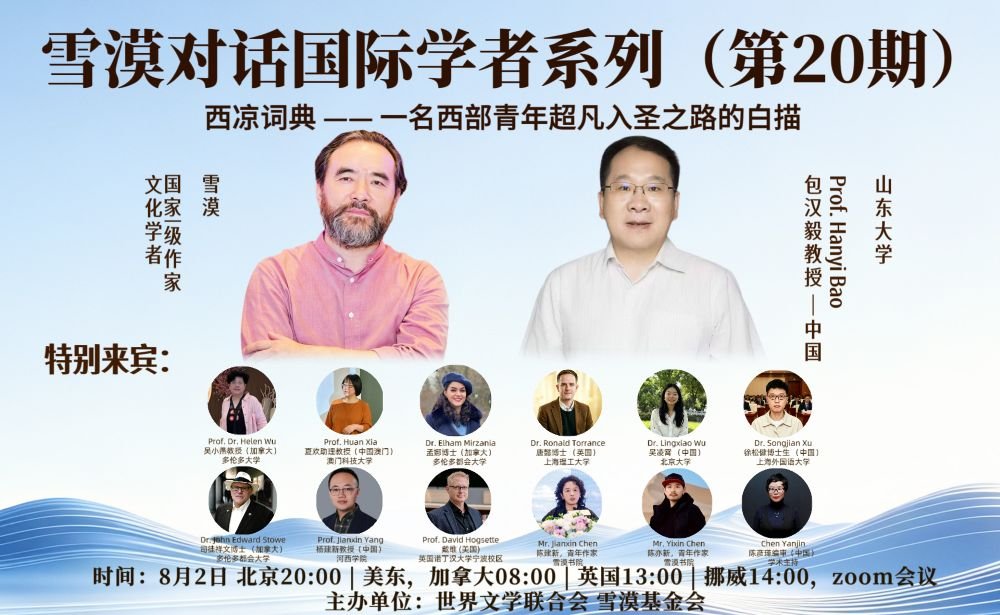
From
A Dictionary of Maqiao to One Man’s West: Bao Hanyi Interprets Xuemo’s
Autobiography; Xuemo Speaks About “Outgrowing the Old Self” for the First Time
“Xuemo in Dialogue with International
Scholars” (Episode 20)
On
the evening of August 2, 2026, the 20th session of “Xuemo in Dialogue with
International Scholars” was held online. Organized by the World Literature
Union and the Xuemo Foundation, the session was titled “The Core of Western
Chinese Literature and New Paths for Cultural Communication.”
The
discussion was moderated by Yanjin Chen, author of The Xuemo Code and Xuemo’s
longtime editor. Professor Hanyi Bao, Dean of the Department of German Language
and Literature, delivered the keynote presentation and engaged in an in-depth
conversation with Xuemo.
More
than 20 scholars and experts from China, Germany, the United States, Canada,
the United Kingdom, Japan, Nepal, and other countries, as well as more than 150
readers of Xuemo’s works, joined the event online.
From
A Dictionary of Maqiao to One Man’s West: A Literary Experiment in
Self-Cultivation
As
Xuemo’s longtime reader and editorial companion, Yanjin Chen opened the
discussion with a question: How can intensive reading help us discover the path
into Xuemo’s literary world?
Professor
Hanyi Bao then presented his interpretation of Xuemo’s autobiography One Man’s
West under the title “From Ordinary to Extraordinary: A Young Man’s Rise in
Western China.”
Bao
compared One Man’s West with Han Shaogong’s A Dictionary of Maqiao. He argued
that, like A Dictionary of Maqiao, Xuemo’s autobiography adopts a fragmented, dictionary-like
structure. Yet, when viewed as a whole, these individual entries form a larger
map of Xuemo’s transformation from an unknown young man in western China into a
widely recognized writer. He gave One Man’s West another name: Xiliang
Dictionary.
Drawing
on traditional Chinese thought, Bao identified several forces that shaped
Xuemo’s growth: filial respect toward elders and siblings and loyalty to his
country; a commitment to doing good and avoiding harm; perseverance through
hardship; the cultivation of the mind through right motivation; the inheritance
of family traditions and local culture; and talent and opportunity in career
development.
Bao
cited several examples from the book, including Xuemo’s response to what he
calls “adversarial bodhisattvas,” and how those people who challenged him
ultimately pushed him to grow faster. He also described how Xuemo continued
writing through harsh winters, sometimes pouring cold water over his head to
stay awake.
For
Bao, Xuemo embodies the spirit of two Chinese traditions: the Confucian ideal
of constant self-improvement and the Buddhist principle of selfless devotion.
“The
greatest value of this book does not lie in showing the cultural landscape of
western China,” Bao said. “It is a witness to how a young man can strive for
constant self-improvement and thrive against all odds.”
Xuemo
Speaks About “Outgrowing the Old Self”: The Key to Individual Awakening and
Cultural Exchange
Responding
to Bao Hanyi’s interpretation, moderator Yanjin Chen raised a question: How can
an individual rise above his circumstances?
Xuemo
offered his first detailed reflection on the relationship between individual
growth and social systems. He argued that most people are shaped by the
“systems” of their era, family, and education, gradually developing what he
called a distinct “collective personality.”
What
makes his own path different, Xuemo said, is his ability to continually
question and transform himself, breaking away from old patterns of thinking,
habits, and assumptions shaped by external systems.
Xuemo
used the precision often associated with German products and the national
character expressed in Russian literature as examples of how culture can become
internalized and shape a collective personality.
He
emphasized that the essence of Eastern wisdom lies in “breaking attachment.”
This means not only releasing attachment to material things but also letting go
of attachment to knowledge, past experiences, and fixed identities.
Once
the limitations of the “small self” are broken, Xuemo said, a person can enter
a state of infinite cosmic consciousness. He explained that this offers a
meaningful interpretation of “Man and Nature in One,” one of the central ideas
in traditional Chinese culture.
Xuemo
added that traditional literature is now facing an unprecedented crisis:
approximately 200,000 books are published in China each year, yet more than 75
percent receive little attention from readers.
The
root cause, he argued, is a “breakup” between literature and its audience.
“Readers
do not ignore literature,” Xuemo said. “They ignore literature that has no
connection with them.”
Using
the global influence of The Bible as an example, he argued that the power of a
great book does not depend solely on its literary qualities. It also requires
the “community power” and “relationship-building” that allow it to reach and
connect with people.
This
perspective strongly resonated with Editor Chen’s long-standing interest in how
literature can become connected with everyday life.
Expanding
the Homeland: From Liangzhou to Maya Civilization and a Shared Origin of
Civilizations
Dr.
John Edward Stowe, a scholar from Canada, asked Xuemo which of his works he
would most recommend to his Western students.
Xuemo
recommended two books: Let Your Heart Be Your Own (Reclaim the Throne of Your
Heart) as an introduction to his philosophical ideas, and Wild Fox Ridge as the
first novel for readers.
He
explained that Wild Fox Ridge is his first innovative work combining literary
narrative with wisdom traditions. It represents a balanced stage in his
development as a fiction writer. By contrast, works such as Desert Rites and
the “Desert Trilogy” are closer to Tolstoy’s literary tradition and are more
suitable for scholarly study.
Later,
Professor Shouhui Zhao of the University of Bergen in Norway raised a personal
question: After leaving one’s homeland, how can one regain a sense of
belonging?
Xuemo
replied that Liangzhou has always been both a form of “limitation” and a source
of “nourishment.”
When
he was young, he desperately wanted to leave his hometown because he realized
that local traditions and social norms could limit his personal development.
Yet after leaving Liangzhou, he gradually discovered that the same land had
given him a confidence and imagination rarely found among contemporary Chinese
writers.
As
his perspective expanded, Xuemo said, the meaning of “homeland” also expanded.
It moved from Liangzhou to Gansu, to China, and eventually to human
civilizations such as those of the Maya and the Inca.
“Human
civilizations share a common origin,” Xuemo said. “When I explored the Maya
civilization, it felt as though I had returned to another homeland.”
Conclusion:
Building a World Literary Community
In
her concluding remarks, Yanjin Chen, author of The Xuemo Code, highlighted the
deeper significance of the discussion. She suggested that the journey from
Professor Bao Hanyi’s “Xiliang Dictionary” to Xuemo’s expanded understanding of
homeland revealed a simple truth: literary creation and academic research
ultimately seek to build more meaningful relationships between people and
between humanity and the world.
Xuemo
also shared that the discussions from the series would be compiled into
publications. Every 12 sessions will be collected into one volume, with each
volume expected to contain approximately 200,000 Chinese characters.
He
encouraged scholars to raise questions freely, including criticism and
difficult questions, because “different opinions are also a source of
nourishment.” At the same time, Xuemo promised to recommend one book by another
author to his readers during his daily livestream, supporting fellow writers
and scholars through his public platform.
This
dialogue among editors, scholars, and writers was not merely an interpretation
of a literary work. It was also an exploration of how literature continues to
connect cultures, individuals, and civilizations.
As
Yanjin Chen observed, Xuemo’s writing and his conversations with international
scholars are together opening a path that begins in the cultural landscape of
western China and extends toward broader questions of world civilization.
The
“Xuemo in Dialogue with International Scholars” program is a weekly webinar
series that takes place every Sunday at 8 p.m. Beijing time.


 Recent Update:
 Commend Reading: