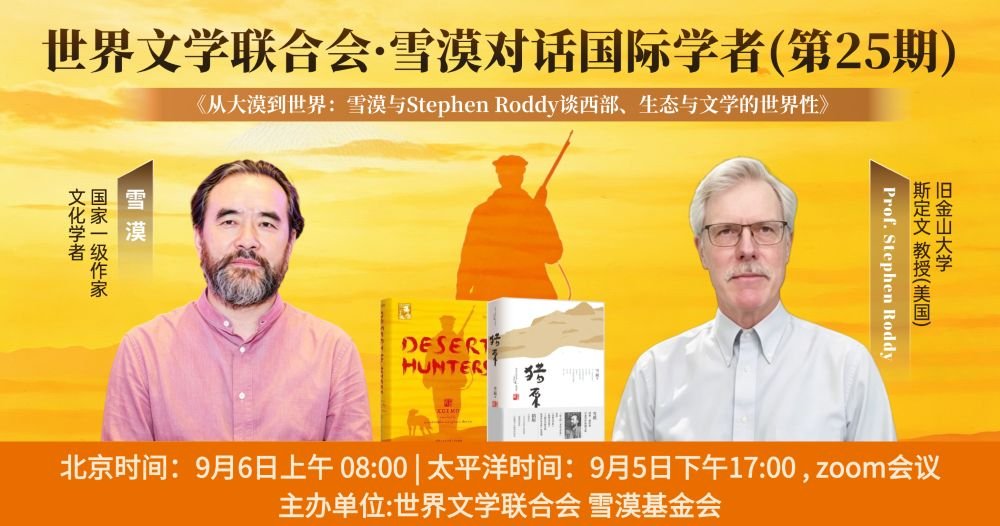
From the Desert to the World: Xuemo
and Stephen Roddy Discuss Western China, Ecology, and the Universality of
Literature
“Xuemo in Dialogue with International Scholars” (Episode 25)
On
September 6, the 25th session of “Xuemo in Dialogue with International
Scholars,” organized by the World Literature Union and the Xuemo Foundation,
was held online. Under the theme “From the Desert to the World: Xuemo and
Stephen Roddy Discuss Western China, Ecology, and the Universality of
Literature,” Xuemo entered into an in-depth conversation with Stephen Roddy,
Professor of Asian Studies at the University of San Francisco. The discussion
ranged across the Hexi Corridor, the experience of western China, ecological
literature, and the ways in which writing rooted in a particular place can
enter world literature. Yanjin Chen, author of The Code of Xuemo, moderated the
talk. The event was attended by scholars from all over the world, young
researchers, and readers.
The
Hexi Corridor and a Writer’s Spiritual Homeland
Roddy,
whose research focuses on East Asian literature and culture, began with the
Hexi Corridor. The region contains the Gobi, desert landscapes, and the Qilian
Mountains, and has long been a meeting ground for different cultures. Han
Chinese culture, Tibetan Buddhist traditions, Hui and Mongolian cultures, and
generations of merchants and travelers along the Silk Road have all left their
traces there. In Roddy’s view, Xuemo’s writing grew from this distinctive
cultural terrain.
Xuemo
welcomed the observation. For him, the desert is a real geographical site and
the space in which his life and writing took shape. Xuemo spent years amid the
vast, silent and harsh landscape of China’s West, and in his work, the Gobi
Desert, living creatures, folk legends, and the life experiences of ordinary
people come alive. The desert is thus his spiritual homeland. The vitality in
his fiction, its broad imaginative scale, and his consistent reflection on life
and death are closely connected to this.
Ecology,
the Wolf, and the Experience of the Land
Roddy
paid particular attention to the ecological awareness in Xuemo’s writing. He
observed that the Qilian Mountains, the Gobi, grasslands, and water sources are
never merely scenery. Wolves, sheep, human beings, a well, and a stretch of
pasture form an interdependent community of life. When water dries up and
grasslands deteriorate, both people and animals lose the basis of survival.
This ecological vision grows from lived experience of the land rather than from
an idea imposed on literature, and it raises questions that extend far beyond
one region.
Turning
to the image of the wolf, Roddy compared Xuemo’s fiction with other
contemporary Chinese works on the subject, including Wolf Totem. Xuemo
explained that in Desert Hunters the wolf does not represent competition,
expansion, or conquest. It is first of all an equal form of life within nature.
Conflict emerges when human beings continually encroach upon the living space
of other species. The deeper question is therefore how people examine their own
desires in relation to nature and how they might rebuild a more harmonious
relationship with other forms of life.
The
conversation placed literature from western China within a broader
world-literary context. In her concluding remarks, moderator Yanjin Chen noted
that Professor Roddy’s questions, which approached Xuemo’s work from the
perspectives of ecology, ethnography, and cultural context, opened up multiple,
in-depth pathways for scholars around the world to interpret his writing.
Xuemo’s responses revealed that his creative work is rooted in a unique lived
experience and transcends the confines of literature alone, flowing into the
vast ocean of a civilization of the heart and mind. In this sense, Xuemo is not
merely a writer, but also a guardian and transmitter of Heart-mind
Civilization.
Heart-Mind
Nature, Cultural Ecology, and the Limits of Inner Change
In
the latter half of the forum, Gaonan Xu, an associate professor at the School
of Translation Studies at Shandong University, turned the discussion toward the
contemporary value of traditional Chinese culture. She asked: In an age of
material abundance and technological advancement, when anxiety and inner
imbalance have become increasingly widespread, what can Eastern wisdom
concerning the heart and mind offer people today, and where are its limits?
Xuemo
replied that institutional problems must be addressed through institutions,
while material problems have their own social mechanisms. Heart-mind
Civilization begins with the individual. Its task is not to solve the external
world by decree, but to foster the transformation of one’s own heart-mind. As
individuals change, the cultural and spiritual ecology around them can
gradually change as well. He added that no one lives entirely on their own:
human behavior is shaped by the environment in which people live, so a person’s
inner change also requires a cultural environment capable of supporting
individual growth.
One
Thousand Hamlets and the Freedom of the Reader
Jionghao
Liu, a postdoctoral researcher jointly trained by the China International
Communications Group and Beijing Foreign Studies University, then approached
the discussion from literary reception. Xuemo has produced a substantial body
of epitext around his works through lectures, interviews, and public talks. Liu
asked whether an author’s continued interpretation of his own writing might
gradually narrow the proverbial “one thousand Hamlets” into a more uniform
reading. He also asked whether interpretations by overseas readers that differ
from the author’s intention or are even negative should be corrected.
Xuemo’s
answer was direct. Once a work is completed, he said, the writer becomes a
reader. Different readers interpret different aspects of the same text
according to their own experience and needs. He compared a work entering the
reader’s heart-mind to a stone falling into water: what matters is the ripple
it creates. Reading gains its meaning precisely from the fact that those
ripples are different.
For
the same reason, Xuemo said that interpretations diverging from the author’s
intention do not need to be corrected. Misunderstanding, questioning, and
criticism can all be part of the exchange. What matters most is that
communication continues. He welcomed critical as well as sympathetic responses,
because literature may thrive and dialogue may last only through interaction
rather than through an authorized interpretation.
A
Forest of Works, Translations, Scholars, and Readers
At
the close of the forum, Xuemo used the metaphor of a forest to describe
literary and cultural ecology. Works, translations, scholars, and readers are
like different forms of life within the same forest. The richer the forest is,
the more vital the ecology is and the more room there is for each participant
to grow.
“From the Desert to the World” therefore describes more than
geographical movement. It is a path by which experience rooted in one landscape
enters other languages, cultures, and minds. The writer is the midwife of a
book. Once the book is done, translation, scholarship, criticism, and reading
continue its life. The desert is the point of origin; the world opens through
each new encounter.

 |
|
 |
|
 |
|


 雪漠推荐
雪漠推荐
 我心中最精彩的青春——《一个人的西部·致