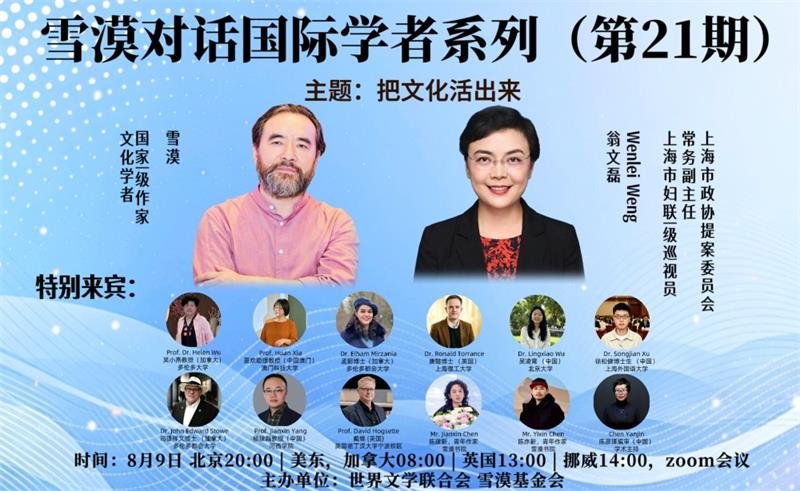
Living Culture: Embodying Tradition in
Everyday Life | Xuemo in Dialogue with International Scholars (Episode 21)
The
twenty-first session of the online forum series “Xuemo in Dialogue with
International Scholars,” organized by the World Literature Union and the Xuemo
Foundation, was held at 8 p.m. Beijing time on August 9, 2026. Under the theme
“Living Culture,” Chinese writer Xuemo entered into dialogue with Weng Wenlei,
Executive Deputy Director of the Proposals Committee of the Shanghai Municipal
Committee of the Chinese People’s Political Consultative Conference and
First-Class Inspector of the Shanghai Women’s Federation. More than a dozen
experts and scholars from China, Canada, Poland, Nepal, and other countries
joined over 200 readers online to explore the deeper relationship between
cultural inheritance and its embodiment in individual lives.
The
Convergence of Lives and the Discovery of a Cultural Character
At
the beginning of the forum, Xuemo explained how the conversation had come
about. A three-time nominee for the Mao Dun Literature Prize and the only
writer invited to the 2026 Oxford Literary Festival, Xuemo has in recent years
extended his research beyond literature into political philosophy. Through
long-term observation and field research, he noticed a group of public servants
working on the front lines of social governance in China. Although they had
received no specialized training in traditional forms of self-cultivation, they
nevertheless displayed remarkable integrity and inner steadiness in everyday
life. Weng Wenlei, he said, was a representative example.
“Many people may practice self-cultivation for a lifetime without
reaching such a state,” Xuemo said. This discovery led him to ask what kind of
strength and experience could enable a person to remain sensitive and gentle
amid demanding public work, and even to live with clarity, ease, and composure.
The question also pointed toward a system through which a “cultural character”
might be cultivated, transmitted, and reproduced. On this basis, Xuemo
introduced the concept of “Xin-Xing Civilization,” arguing that beyond material
and institutional civilization, the cultivation of the inner life is the
foundation of both social stability and personal well-being. The dialogue
therefore sought, through Weng’s upbringing and life experience, to identify
the cultural inheritance that people “use every day without being aware of it.”
The
Nourishment of Family and a Character Grounded in Public Responsibility
Responding
to Xuemo’s questions, Weng organized her reflections around three words:
encounter, sharing, and connection. She recounted how she had come to know
Xuemo’s works and how profoundly her family upbringing had shaped her
character.
Weng
said candidly that her background in psychology had not spared her from an
inner conflict between trying to face the pressures and realities of life and
work calmly and presenting the outward image of a capable “strong woman.” The
difficulty of bringing knowledge and action into alignment left her physically
and emotionally exhausted, and at certain stages of her life she suffered from
persistent illness. In the second half of 2022, she happened upon Xuemo’s The
Undying Diamond Heart, Eternal Love, and Curses of the Kingdom of Xixia. Their
accounts of transcending suffering and remaining steadfast in one’s convictions
affected her deeply. What she initially found difficult to read soon became
something she read voraciously. Xuemo’s writing not only helped settle her
inner life, but also enabled her to move from a state of tension toward greater
ease.
Looking
back on her upbringing, Weng spoke affectionately about her parents. Raised in
a large and loving family, she inherited the kindness, warmth, and sense of
responsibility of her engineer father, whom she described as a typical Shanghai
man, as well as the concentration, rigor, and intelligence of her mother, a
high-school mathematics teacher. Her parents never placed academic pressure on
her. Instead, they encouraged her to pursue her interests freely and fully
respected her wishes even when she had to choose between academic strengths and
athletic interests. “Whatever I liked, I went and did,” she recalled. This
relaxed and trusting family atmosphere nurtured her independence, tolerance,
creativity, and seemingly instinctive sense of mission.
After
listening to Weng, Xuemo said that she embodied a rare “character of public
responsibility.” Such a character transcends utilitarian calculation, social
roles, and gender, and manifests as an instinctive sense that everyone bears
responsibility for the fate of society. Drawing on his observations of
grassroots governance in China, Xuemo argued that China’s ability to maintain
stability and development amid a complex global environment rests in part on
the many outstanding public servants like Weng who quietly shoulder public
responsibilities in their respective positions without placing personal gain
first. Such a character, he said, is not simply innate, but a distinctive fruit
cultivated jointly by contemporary Chinese cultural life and family upbringing.
Embodying
Culture: From Helping Others Flourish to Living as Oneself
Weng
then discussed how culture can be embodied in everyday life. For her, living
culture is expressed not only through large forms of social responsibility, but
also in the smallest human interactions.
She
described her guiding principle in relationships as “helping others flourish.”
Whether supporting younger colleagues at work or helping a domestic worker
resolve difficulties with a child’s schooling, she has tried to treat those
around her with the same generosity she herself has received. She believes that
if everyone could become a benefactor in someone else’s life, society would
become a better place. This practice of helping others find fulfillment is a
contemporary expression of the Confucian idea that “the humane person loves
others.”
Weng
and Xuemo also spoke candidly about declining birth rates and the growing
number of women living alone. Citing research by Nobel Prize-winning economist
Claudia Goldin, Weng said that men’s understanding of their role within the
family and the extent of their participation in family life are important
factors affecting birth rates. She called on men to shoulder family
responsibilities and cultivate fidelity, benevolence, and dependability,
devoting genuine care and feeling to family life. Xuemo strongly agreed. He
suggested that some men today lack inner strength and a willingness to take
responsibility, which is one reason some women would rather remain single than
settle for an unsuitable relationship. With humor, he urged men to recover
their inner strength and shape themselves into “works of art” worthy of a
woman’s trust.
Trial,
Error, and Growth in Education
Toward
the end of the conversation, the two speakers exchanged views on the growth and
education of young people. Weng recalled that her daughter had once described
her as having a “people-pleasing personality,” arguing that she took on too
much responsibility for others and suppressed herself when she could not meet
every demand, eventually harming her health. Weng said she did not agree with
that interpretation. Xuemo offered another perspective through the experience
of his own son.
Xuemo
argued that rebellion and exploration are indispensable parts of youth. “Every
experience ultimately becomes a form of wealth,” he said. Parents should not be
excessively harsh when educating their children. They need only uphold two
basic limits: do not harm others, and leave those you encounter feeling at
ease. Young people need to pass through setbacks and, through the accumulation
of experience, undergo transformation and eventually awaken to themselves. He
cited his son Chen Yixin, who gave up a career choice in order to remain with
his mother, praising the younger generation’s willingness to sacrifice for
filial care and responsibility. This kind of cultural inheritance, embodied in
practice, he said, is more precious than anything learned only from books.
Xuemo
emphasized that culture is not something to display, but something that should
transform life. A genuine cultural character is formed little by little through
everyday practice. Weng’s diligence and sense of responsibility in public
service, and the tenderness ordinary people bring to family life, are both
concrete expressions of culture made manifest in life.
Culture
Enters Everyday Life
The
conversation lasted more than two hours, ranging from family upbringing to
social governance and from women’s independence to the growth of young people,
while bringing theoretical discussion together with personal experience. In her
concluding remarks, moderator Lei Yiting said that the dialogue showed that
culture is never a lofty doctrine removed from life. It is the upbringing that
flows in one’s blood and the sense of responsibility embodied in one’s actions.
As Xuemo observed, the ultimate purpose of literature and culture is not to be
enshrined in an ivory tower for study, but to enable countless readers to draw
strength from them and transform their own lives. When each person can shoulder
public responsibility while embodying the spirit of culture, culture truly
enters everyday life.

 |
|
 |
|
 |
|


 雪漠推荐
雪漠推荐
 我心中最精彩的青春——《一个人的西部·致