Xuemo’s “Living Transmission” Paradigm
Reshapes the Global Circulation of Chinese Wisdom for Living | Xuemo in
Dialogue with International Scholars (Episode 23)
On
the evening of 23 August 2026, the twenty-third online forum in the “Xuemo in
Dialogue with International Scholars” series was held under the auspices of the
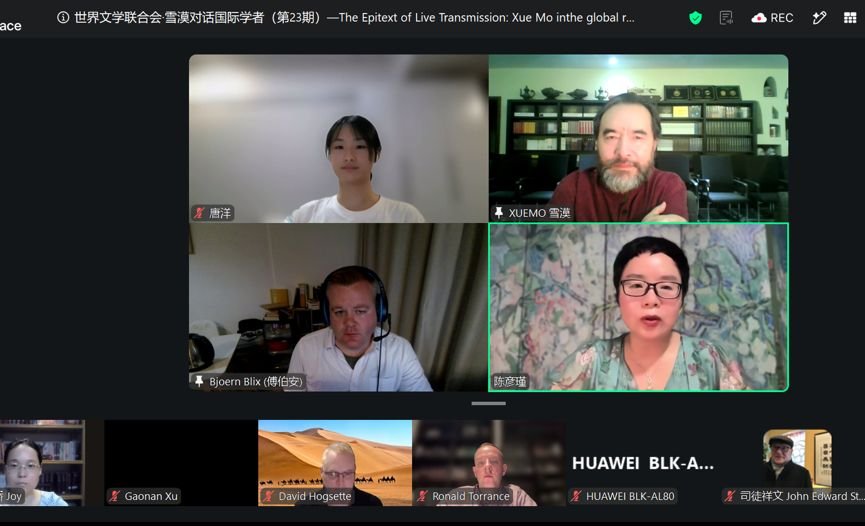
World Literature Union and the Xuemo Foundation. The forum, themed
“Constructing the Epitext of Living Transmission: Xuemo and the Global
Reception of Chinese Wisdom for Living,” invited Norwegian scholar Bjoern Aage
C. Blix, postdoctoral researcher at the School of Foreign Languages of Hunan
University, and Tang Yang, a doctoral student at the same school, to engage in
an in-depth dialogue with author Xuemo. More than twenty scholars from China,
Norway, Canada, the United Kingdom, Poland, Singapore, Nepal, and other
countries, together with over 180 readers worldwide, participated online. The
forum was moderated by Yanjin Chen, senior editor of Xuemo’s works and author
of The Xuemo Code.
A
Theoretical Breakthrough: From Writing “About China” to Speaking “from China”
Dr
Blix argued that for centuries the Western reception of Chinese spiritual
wisdom had largely been shaped through external interpretation. From early
Jesuit missionaries to modern sinologists, many important scholars contributed
to the global dissemination of Chinese culture, yet Chinese spiritual
traditions were often approached as objects of study rather than as living
traditions.
The
result was a form of “structural silence”: texts reached readers without the
living voices, practices, and experiences that had produced them. Readers were
therefore often left to interpret Chinese wisdom through their own cultural
frameworks.
According
to Blix, Xuemo represents a structural shift. Unlike previous mediators who
mainly interpreted or translated existing traditions, Xuemo’s writing emerges
from decades of lived spiritual practice. His works combine literary creation,
personal realization, and direct engagement with global readers. Through this
integration, readers encounter Chinese tradition not merely as an object of
knowledge but as a lived experience.
Epitext
and the Transformation of Reading
Drawing
on Gérard Genette’s theory of paratext and Hans Robert Jauss’s concept of the
“horizon of expectations,” Blix proposed that Xuemo’s epitextual presence
provides a key framework for understanding his works. Epitext includes material
beyond the physical book, such as author interviews, public lectures, academic
dialogues, and cultural exchanges.
Xuemo’s
ongoing global conversations, including weekly forums and international
literary events, create an interpretive environment in which readers approach
his works differently. His novels are no longer viewed only as fictional
narratives; they become vehicles through which Chinese wisdom for living is
encountered.
To
illustrate this point, Blix and Tang Yang conducted a simulated reader-response
analysis of a passage from Desert Rites. They distinguished between “cold
readers,” who encounter the text without knowledge of Xuemo’s lived experience
and public discourse, and “deep readers,” who understand the spiritual context
behind the writing.
Cold
readers may appreciate the beauty of the prose and see the desert as a physical
landscape. Deep readers, however, perceive symbolic meanings: the desert
becomes a site of spiritual cultivation, the fire becomes a symbol of inner
awakening, and the characters’ journey becomes a process of transformation.
As
Tang Yang explained, epitext provides readers with a key to interpretation. It
transforms their relationship with literature from consumption toward learning
and participation.
Lived
Realization Beyond the Translation of Words
Responding
to questions about the communication of Chinese culture, Xuemo emphasized the
difference between intellectual explanation and lived realization. Western
philosophy, he suggested, often emphasizes rational construction, while Chinese
culture places greater emphasis on realization through life practice.
Words
alone cannot fully convey the state of life behind them. The deeper challenge
in cross-cultural communication is not simply translation accuracy, but whether
the lived experience embodied in a tradition can also be transmitted.
Xuemo
explained that he does not write to follow literary trends or pursue
recognition. His writing is the result of living the principles he expresses.
He described Xuemo as a complete world consisting of literary works, personal
conduct, readers and students, and international translators and scholars.
These elements form an integrated whole.
Therefore,
his epitextual presence is not a deliberate promotional strategy. It is a
natural extension of his way of life.
Building
a New Paradigm of Living Transmission
During
the discussion, participants emphasized that the significance of the forum
extended beyond literary interpretation. It explored a new model of cultural
transmission in which theory meets lived experience.
Yanjin
Chen observed that Blix and Tang Yang began with theoretical concepts but
ultimately reached the lived reality of Xuemo’s world. Their research, together
with Xuemo’s own account of his practice, revealed that cultural communication
requires more than textual analysis alone.
The
concept of “living transmission” suggests that Chinese culture can enter global
dialogue not only through translation but also through practitioners who embody
and express tradition through their lives.
Conclusion:
A Thousand Rivers, A Thousand Reflections of the Moon
The
forum crossed boundaries of language, culture, and academic tradition. Through
dialogue between international scholarship and lived Chinese experience, it
demonstrated a possible path for contemporary Chinese literature to engage with
the world.
Xuemo’s
life practice shows that literature can become more than a text: it can become
a bridge connecting writer, reader, tradition, and future generations.
As
the saying goes, “A thousand rivers have a thousand reflections of the moon.”
Through the bridge of epitext, the wisdom embodied in Xuemo’s life continues to
illuminate hearts around the world in search of a spiritual home.

 |
|
 |
|
 |
|


 雪漠推荐
雪漠推荐
 我心中最精彩的青春——《一个人的西部·致