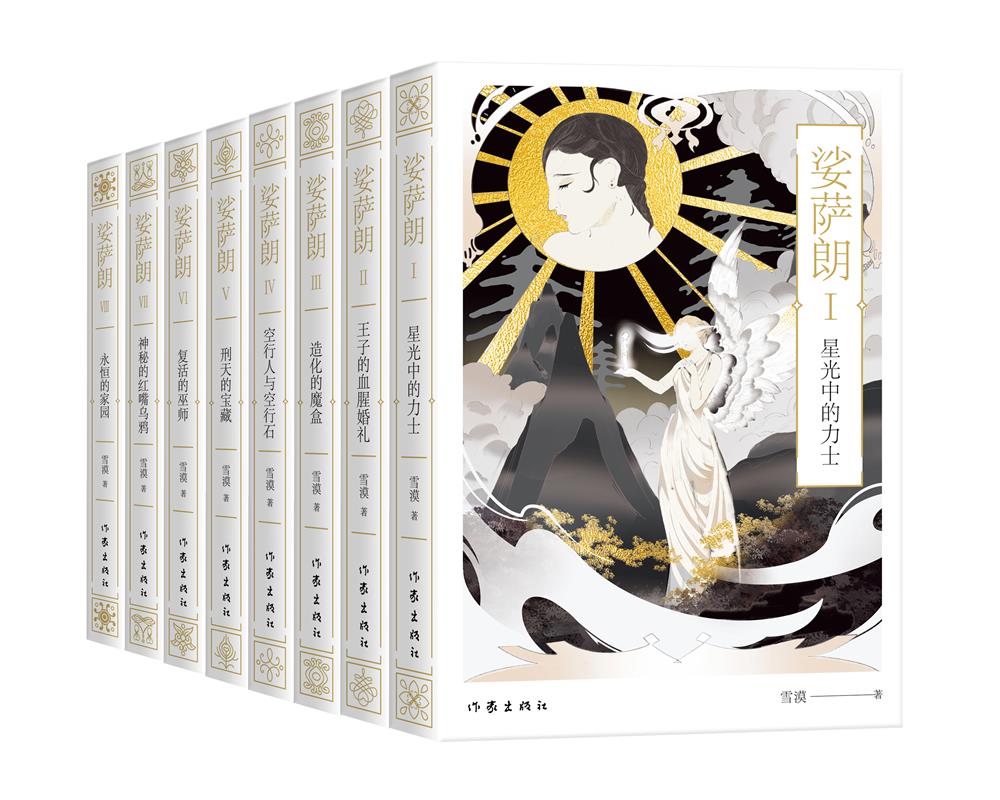
Suosalang
and the Search for a New Model of Civilization | “Xuemo in Dialogue with
International Scholars” (Episode 3)
On
March 15, 2026, scholars from China, Germany, Norway, Canada, the United
Kingdom and Iran gathered online to discuss an old philosophical question made
more urgent by artificial intelligence: What forms of knowledge help people
live, rather than simply give them greater power over the world?
The
two-hour forum, organized by the World Literature Union and the Xuemo
Foundation, was the third international dialogue devoted to Suosalang, Xuemo’s
eight-volume epic. Participants examined the work’s philosophical foundations
and Xuemo’s idea of Xin-xing Civilization (心性文明), a form of
civilization grounded in the cultivation of the heart-mind and human nature.
The
meeting took place one day after the death of Jürgen Habermas, the German
philosopher whose work on communicative reason, democracy and the public sphere
shaped postwar intellectual life. Yanjin Chen, author of The Xuemo Code and
moderator of the forum, opened with a remembrance of Habermas and a question
prompted by his concerns about philosophy’s future: What role remains for
philosophy in a world increasingly governed by technological rationality?
Xuemo
and Professor Hanyi Bao, Chair of the Department of German at Shandong
University, approached that question through Suosalang, placing the epic within
a wider debate about technology, moral judgment and the direction of modern
civilization.
What Philosophy Can Still Ask
Chen
began by asking whether Suosalang represented an attempt to formulate a new
philosophical system at a time when technical power was expanding while
questions of value and meaning were receding from public life.
Xuemo
answered by reflecting on his travels. Human beings possess vast stores of
knowledge and technologies of extraordinary reach, he said, but much of what
they pursue has little bearing on the basic experience of being alive.
Institutions, intellectual systems and political conflicts may appear
all-important in public life, yet lose their urgency when a person turns inward
and considers what is essential.
Suffering,
he argued, often begins with attachment to things that are not necessary for
life itself.
Xuemo
described modern Western civilization as being shaped by an impulse toward
outward conquest, an impulse he believes has reached a crisis amid continuing
wars and social fragmentation. Suosalang, he said, was his attempt to imagine
another possibility.
That
alternative does not reject knowledge or technology. It asks, instead, what
must be cultivated within human beings if knowledge and technology are to serve
humanity responsibly. Xuemo calls this inward orientation Xin-xing
Civilization.
The
Chinese term xin-xing brings together two closely related ideas: xin 心,
referring to the inner realm of the heart-mind or psyche, and xing 性,
meaning inherent nature. In Xuemo’s usage,
Xin-xing Civilization measures progress not by material achievement but by the
cultivation of concentration, discernment, compassion, and moral character.
Through
its interwoven narratives, Suosalang seeks to lead readers away from
distraction and toward what Xuemo regards as the essentials of life. The epic
asks whether an inner clarity, as immediate as breathing, might provide a basis
for both individual freedom and collective life.
The Five Warriors
During
the forum, Xuemo publicly explained the symbolic structure of five central
figures in Suosalang, known collectively as the “Five Warriors.” Each
represents one aspect of personal realization and its expression in the world.
Huanxi,
perfection of mind: Huanxi represents the spiritual condition reached when
ordinary mental limitations have been transcended.
Miji,
perfection of body: Miji represents altruistic conduct guided by a cultivated
mind.
Huanhua,
perfection of speech: Huanhua represents the use of language to communicate
ethical values and challenge wrong assumptions, including the glorification of
violence.
Shengle,
perfection of merit: Shengle represents tangible contributions to the lives of
others. A philosophy that produces no beneficial consequences, Xuemo cautioned,
can itself become harmful.
Weide,
perfection of enlightened activity: Weide represents the wider influence of
spiritual realization. A civilization can shape the world, Xuemo said, only
when its principles become part of everyday life.
Together,
the five figures connect spiritual cultivation with action. Inner change, in
this account, remains incomplete unless it affects how a person speaks, acts
and contributes to society.
Xuemo
said that when these five dimensions are brought together, they make possible a
new “Suosalang,” not simply as a place within the epic but as an imagined
spiritual homeland.
Writing Beyond the Limited Self
Professor
Bao asked why Xuemo had chosen the epic form and what kind of creative state
had produced a work of such length.
Xuemo
said the epic gave him the scale needed to hold what he perceived as a single,
interconnected whole. He also believed that its form could carry philosophical
ideas without separating them from narrative, character and experience.
He
described his method as “egoless writing.” Through literary discipline and
spiritual practice, he said, a writer can loosen their attachment to the
limited self and gain access to a larger field of awareness. He compared that
field to an infinite “corpus of wisdom.”
The
metaphor is quite contemporary, but the underlying idea is very old: the
principle of “Man
and Nature in One” (天人合一), in which the
writer does not create through personal will but becomes receptive to something
larger than himself, the Dao or the universe.
In
this model, the text becomes a conduit for the writer’s inner realization.
Readers who approach the text seriously may enter the imaginative and spiritual
world of the work and find their own perceptions transformed by it.
Literature After Artificial Intelligence
The
discussion then turned to whether literature retains its value when artificial
intelligence can produce fluent prose almost instantly.
AI
can imitate language, Xuemo said, but it cannot substitute for the
transformation of consciousness from which major literature arises. Literary
value, in his account, depends not only on verbal skill but also on the
writer’s moral character, experience and degree of inner development.
Yet
Xuemo did not treat AI solely as an adversary. He argued that it could weaken
barriers created by concentrated wealth and restricted access to knowledge,
allowing philosophical and spiritual ideas to circulate more widely.
The
distinction, as he presented it, lies between using technology as an tool and
allowing technological systems to determine the purposes of human life.
Xuemo
also recommended reading Suosalang aloud rather than reading it silently. He
believes that vocal rhythm, repeated language, and textual meaning can work
together to affect the reader. This claim reflects his understanding of
literature as an embodied practice rather than a purely intellectual exercise.
Can an Epic Travel Across Cultures?
The
international circulation of Suosalang raised another set of questions. Xuemo
argued that contemporary societies shaped by Western institutions could benefit
from closer engagement with Eastern wisdom traditions.
The
biggest challenge, he said, is not that the content is difficult to digest.
Rather, it is our loss of sustained attention in a world driven by commercial
pressures and fragmented information. As a result, people may find it almost
impossible to finish lengthy works or remain connected with their inner selves.
Xuemo
proposed that education, animation and immersive digital media could help bring
these ideas into contemporary settings. Such adaptations, he suggested, might
allow inherited forms of wisdom to enter the habits and media of a new
generation.
Near
the close of the forum, he discussed “Niguma Khyenno,” an invocation repeated
throughout the epic. Xuemo described it as a “code of the mind” through which a
practitioner seeks a connection with a higher form of wisdom.
He
also drew an analogy with quantum entanglement. The comparison was presented as
a philosophical metaphor rather than a scientific demonstration. According to
Xuemo, the invocation’s effect depends on the practitioner’s confidence,
receptivity and sustained practice.
An Argument About Progress
The
forum did not establish Xin-xing Civilization as a finished philosophical
system, nor did it resolve the tension between technological development and
inner cultivation. It did, however, clarify the argument at the center of
Suosalang.
Material
and technical progress, Xuemo contends, cannot by themselves answer questions
about how people should live, what they should value or how power should be
used. Those questions require another form of development, one concerned with
the quality of attention, the formation of character and the relationship
between inner inquiry and public service.
The
scholars’ questions placed these claims under examination and opened several
lines of inquiry for future work on the epic. Among them is a question that extends
beyond Suosalang: Can a civilization increase its command of the external world
without losing the capacity to understand the human beings who inhabit it?

 |
|
 |
|
 |
|


 Mobile
  雪漠推荐
雪漠推荐
 我心中最精彩的青春——《一个人的西部·致