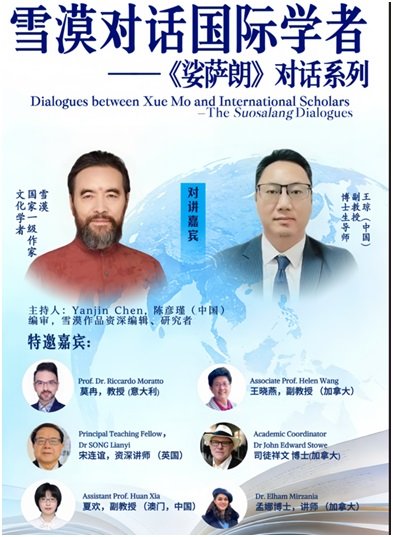
East
Meets West in a Discussion of Humanity’s Future | “Xuemo in Dialogue with
International Scholars” (Episode 1)
Scholars
and sinologists from China, Italy, Canada, the United Kingdom, and Iran met
online on February 8, 2026, for the first International Dialogue on Suosalang.
The World Literature Union and the Xuemo Foundation organized the event to
discuss Xuemo’s eight-volume epic and the questions it raises about literature,
philosophy, and the future of society.
Yanjin
Chen, a senior editor at People’s Literature Publishing House and Xuemo’s
longtime editor, moderated the discussion. She said the series would bring
scholars from different countries and disciplines together to examine the
literary and cultural significance of Suosalang and consider how the work might
be read outside China.
Literature, Science Fiction, and the
Search for Another Way of Living
One
of the day’s main subjects was the relationship between Suosalang and science
fiction.
Xuemo
said that he did not write Suosalang as a conventional narrative epic. He
wanted the work to ask whether humanity could build a kind of society different
from those it already knows.
He
contrasted his literary project with Elon Musk’s pursuit of technological
innovation and space exploration. While Musk looks outward through science and
technology, Xuemo said, he works through literature and art. The several worlds
called “Suosalang” in the epic represent different ways in which human
civilization might develop.
Professor
Qiong Wang of Guangxi Minzu University asked whether artificial intelligence
could create a new world if the present one were destroyed. She also asked
Xuemo to identify the epic’s main literary theme.
Xuemo
suggested that artificial intelligence might one day be understood not simply
as a set of algorithms but as a form of intelligence with some agency of its
own. Even so, he said, AI should remain a means of inquiry rather than an end
in itself.
The
epic’s main direction is inward. Xuemo contrasted this with what he sees as the
Western tendency to conquer and control the world outside the self. Suosalang
turns inward insteadand asks how people might strengthen their capacity for
love and wisdom.
Wang
related this idea to philosophical discussions of immanence. She also noted
that the search for an “eternal light” runs through the epic and that light
appears as a spiritual symbol in many religious and cultural traditions.
When
asked which character he admired most, Xuemo named Shengle. He said the
character does not simply suppress desire but learns to face and transform it.
Through trials and tribulations, Shengle finally awakens to the true nature of
himself and the world.
Xuemo
said the book rests on one claim: each person can draw on love and wisdom to
create a utopia, a “Suosalang” of his or her own.
What an Inward Search Might Offer
Contemporary Readers
The
discussion then turned to what Suosalang might mean to readers from different
cultural backgrounds.
Italian
sinologist Riccardo Moratto placed his question in the context of the Western
epic tradition. At a time when technology is weakening familiar sources of
meaning, he asked which part of Suosalang’s inward search might speak most
directly to Western readers accustomed to mastering the external world.
Xuemo
replied that the more people investigate the world around them, the more they
may recognize the role played by the perceiving mind. He argued that people
must reclaim their inner sovereignty, grounded in love and wisdom, if they are
to avoid being ruled by money and desire and learn to live together peacefully.
Professor Helen Wu asked how people
living in large Canadian cities might read the book.
Xuemo
answered with the image of a cup. City life, he said, can confine a person’s
experience to a narrow vessel. By portraying the landscapes and everyday life
of western China, Suosalang can enlarge that vessel. It can give readers a
wider measure by which to judge their anxieties, ambitions, gains, and losses.
Dr.
Lianyi Song of SOAS University of London asked Xuemo about an image that often
appears in his writing: “a lamp within the heart.”
Xuemo
said such a lamp should bring four things: love, wisdom, health, and happiness.
A belief that fails to produce these results should not automatically be
treated as a source of guidance. Some convictions lead people toward violence
or destruction and must be questioned.
Dr.
Elham Mirzania approached the book through Persian Sufi writing, in which
suffering can lead to spiritual change.
Xuemo
called suffering an integral part of life. It may become a gift, he said, but
its meaning depends on the choices a person makes when facing it. Pain alone
does not transform anyone; the response to pain does.
Dr.
Huan Xia of the Macau University of Science and Technology, along with Dr. John
Edward Stowe and Dr. Mirzania of Toronto Metropolitan University, raised
further questions about belief, spiritual strength, the writer’s state of mind,
and the survival of civilizations.
Xuemo
answered by describing five elements that, in his view, give strength and
direction to a person’s life: dao, the underlying way or principle; de, moral
character; fa, methods and rules; shu, practical skills; and shi, the force
created by circumstances. These elements, he said, help turn inward
understanding into conduct.
Literature and the Future
Although
the meeting began with a single literary work, the conversation ranged across
science fiction, philosophy, city life, Sufi writing, technology, and religious
belief. Again and again, the speakers returned to the same question: Can
changes in the human mind keep pace with changes in the tools human beings
create?
The
discussion also considered whether literature still has a part to play in an
age increasingly governed by technology. For Xuemo, its task is not to supply
ready-made answers but to help readers examine their desires, fears, and
responsibilities more honestly.
The
session ended with an online group photograph. It left two questions for later
meetings: whether technological progress can be matched by moral and spiritual
growth, and whether literature can help people imagine a future governed by
more than wealth, power, and efficiency. The forum marked the beginning of an
international discussion of Suosalang and the view of human life presented in
its pages.

 |
|
 |
|
 |
|


 雪漠推荐
雪漠推荐
 我心中最精彩的青春——《一个人的西部·致